
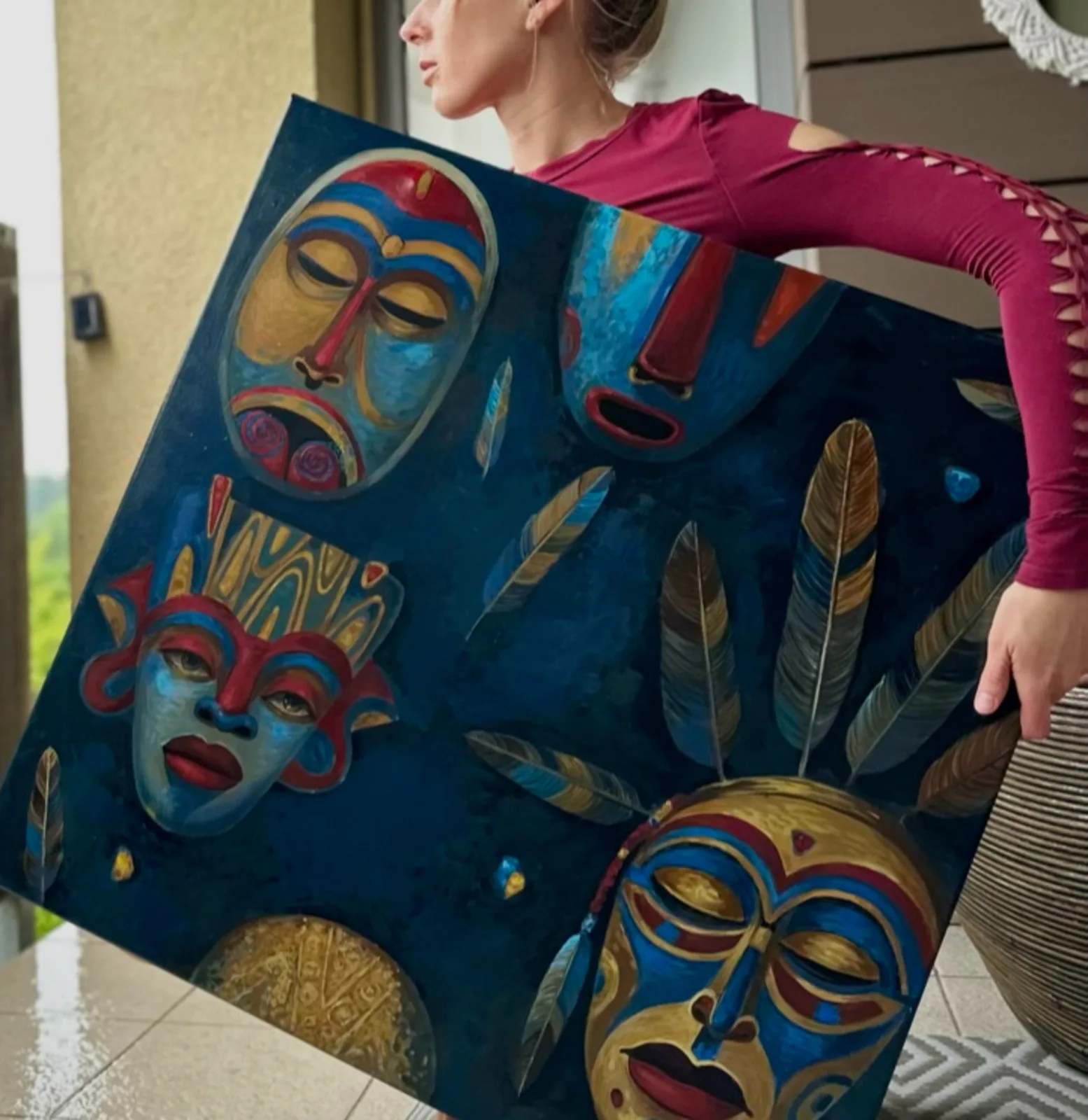
Why do I love the square format?
(And I don't even fully know why...)
I'm not sure whether it's a conscious or an intuitive choice, but the square is the format I reach for most often.
Maybe because it doesn't impose anything. It doesn't say: "I'm a landscape," "I'm a portrait." It's equal on all sides.
It has something clean, stable, and honest about it.
From a compositional point of view — it's the most honest form.
It doesn't favour any single axis. It doesn't "pull" the eye sideways or upward.
It gives freedom — every line, every colour can spread out in every direction with the same force.
The square in art history
In modern art, the square took on special significance.
Malevich's Black Square became an icon — a radical gesture that broke away from representing the world.
For Mondrian — the square was structure, system, rhythm.
For many artists — it's a field for experimentation and silence.
The kind of silence where you can breathe without background, without context, just with colour, line, emotion.
I've always been drawn to folk patterns, to handicrafts, to ornaments that repeat something, that arrange something.
In many cultures the square is a form representing earth, foundation, rhythm.
In fabrics, tiles, embroidery — it appears everywhere as a module. Repetitive, rhythmic, a little hypnotic.
It gives a sense of being rooted, and it ties art to everyday life. Maybe that's why I feel so at home in this format — because it connects intuition with tradition.
Comments
No comments yet. Be the first!